
Claude Skills vs Kiro Powers: Comparison and Integration StrategiesBy Dzulkiflee Taib
Overview
I have been watching the "agent extensions" space turn into a bit of a jungle. Everyone wants their AI assistant to be better at a specific task, but the way we get there is now split across two very different philosophies. On one side you have Claude Skills (model-invoked guidance). On the other you have Kiro Powers (IDE-invoked guidance plus tools). Same goal. Different wiring.
If you only remember one line, make it this: Skills teach the model. Powers equip the model.
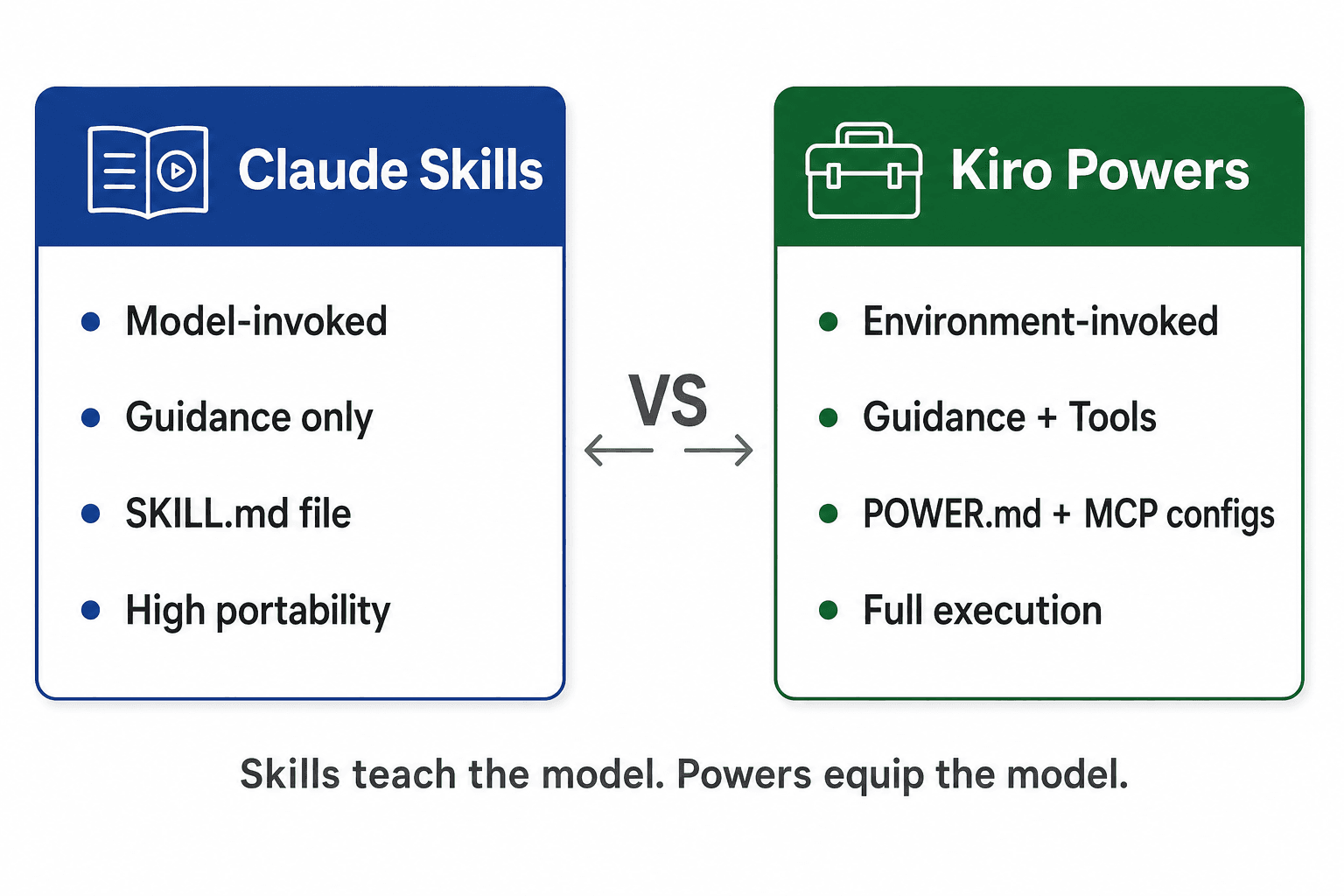
Table of Contents
- The Short Version
- Claude Skills: The Model Pulls the Playbook
- Kiro Powers: The IDE Brings the Toolbox
- Side-by-Side Comparison
- What Breaks in Real Life
- Integration Strategies (Do This Today)
- My Recommendation (Based on How Teams Actually Work)
- Sources
The Short Version
If you care about portability and speed of authoring, Skills are your friend. If you care about end-to-end execution, Powers are the clear winner. I like Skills for teaching and Powers for doing.
Claude Skills: The Model Pulls the Playbook
Claude Skills are packaged guidance modules that the model itself decides to load. A skill is typically a SKILL.md file with a short description and the instructions the model should follow when a task matches the skill's scope. This is clean and lightweight, which is why skills have taken off across tools. See the official Claude Skills overview and how to create skills.
What a good Skill includes:
- A tight description with clear triggers.
- A repeatable process the model can follow.
- Examples that reduce ambiguity.
- References that keep it grounded.
Why I like Skills:
- Easy to write and share.
- Easy to reason about.
- They improve output quality without changing your tooling.
- The skills.sh ecosystem makes discovery painless.
Where they fall short:
- No real tool access.
- Depends on the model triggering the right thing at the right time.
- Fragmented setups across IDEs if your team uses different stacks.
Kiro Powers: The IDE Brings the Toolbox
Kiro Powers are AWS Kiro's answer to the same problem, but with a more "full stack" philosophy. A power is not just guidance. It is guidance plus tooling. Kiro's Powers documentation explains how the IDE loads a power based on trigger keywords and injects its guidance along with the tools (via the Model Context Protocol).
Each power typically includes:
POWER.md(steering and activation triggers)- MCP configuration (tools and permissions)
- Optional hooks or sub-guides
Why Powers are strong:
- They let the agent take action, not just give advice.
- They keep context clean by loading only what is relevant.
- They remove the "but how do I run this?" gap.
The trade-offs:
- You are currently tied to Kiro.
- Authoring takes more setup.
- Tool permissions need to be managed carefully.
Side-by-Side Comparison
| Dimension | Claude Skills | Kiro Powers |
|---|---|---|
| Activation | Model-invoked | IDE/environment-invoked |
| Scope | Guidance only | Guidance + tools |
| Files | SKILL.md | POWER.md + MCP configs |
| Portability | High | Low (today) |
| Authoring effort | Low | Medium to high |
| Best for | Guidance, best practices | Execution, workflows |
What Breaks in Real Life
This is where the glossy demos end.
- Skills fail silently if the triggers are too broad or too narrow.
- Powers can be over-permissioned if you are not careful with tool access.
- Teams split across tools end up maintaining parallel systems (skills here, powers there).
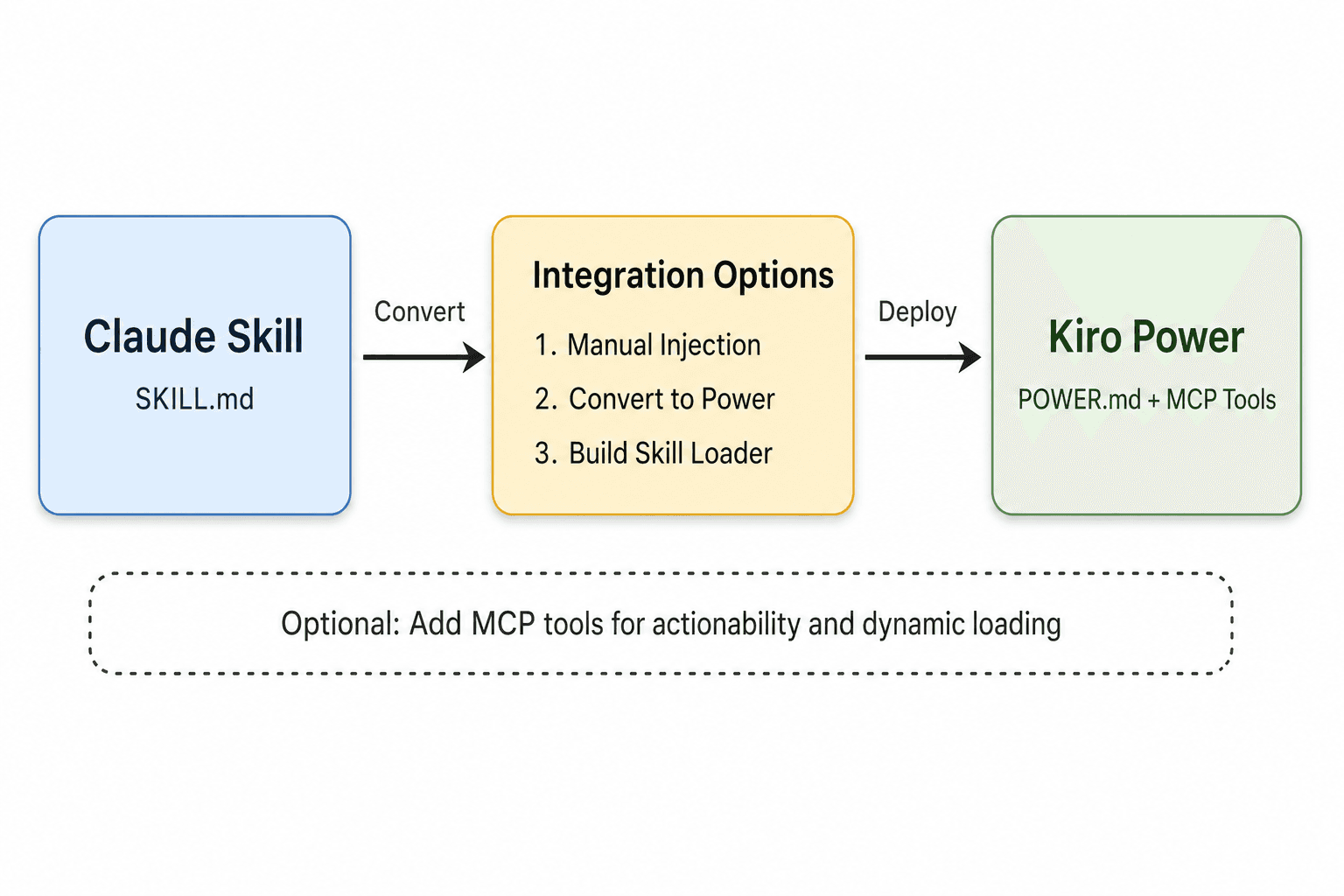
Integration Strategies (Do This Today)
1) Manual Injection (Fastest)
If you just need a skill once, paste the guidance into the chat or a project note. It is not elegant, but it works.
2) Convert Skills into Powers (Best Long-Term)
If you rely on a skill weekly, convert it into a power:
- Move guidance into
POWER.md. - Translate triggers into power keywords.
- Add any supporting files.
- Decide if you need MCP tools.
3) Build a "Skill Loader" Power (Ambitious)
A meta-power can fetch skills on demand and inject them into context. This is not mainstream yet, but it is the logical bridge if you are all-in on Kiro and you love the skills ecosystem.
My Recommendation (Based on How Teams Actually Work)
If you are experimenting, use Skills. If you are shipping, use Powers. If your team straddles both, pick the three most valuable skills and convert them into powers. That gives you 80 percent of the value without drowning in migration work.
Update — April 2026
The landscape has shifted significantly since this article was published in January. Here is what changed and what still holds.
Skills Are No Longer "Guidance Only"
The biggest shift: Claude Skills now run code, generate files, and produce real deliverables. Anthropic shipped pre-built Skills for Excel, PowerPoint, Word, and PDF that execute actual operations. Claude Code Skills support subagent execution, dynamic context injection, and invocation control (choose whether you or Claude triggers a skill). The original claim that Skills offer "no real tool access" is no longer accurate.
Claude Code also merged custom commands into Skills — a /deploy command and a skill at .claude/skills/deploy/SKILL.md now work identically.
Skills Became an Open Standard
Skills are no longer Claude-specific. The Agent Skills open standard has been adopted by 32+ tools including OpenAI Codex CLI, Cursor, ChatGPT, and more. The portability advantage I described in January turned out to be even stronger than expected — Skills are now the closest thing the industry has to a universal agent capability format.
The skills.sh ecosystem grew from a directory into a full marketplace with CLI installation, launched by Vercel in late January 2026.
Powers Are Opening Up
Kiro Powers announced cross-compatibility with other AI development tools ("coming soon"). Launch partners now include Datadog, Dynatrace, Figma, Neon, Netlify, Postman, Supabase, Stripe, and AWS Strands Agents. The "tied to Kiro" limitation is dissolving.
The community Powers repository continues to grow with contributions from partner integrations.
The "Skill Loader" Prediction Came True
In the original article I described building a "Skill Loader" Power as an "ambitious" integration path. Three months later, this is exactly what shipped — both as the skills.sh CLI and as standalone tools like the Skill Loader MCP Server that can discover, fetch, and convert skills on demand.
Revised Recommendation
The original thesis — "Skills teach, Powers equip" — still captures the design philosophy difference. But the practical gap has narrowed considerably:
- Skills now execute, not just advise. If your skill needs to run a script or generate an artifact, that works natively.
- Powers still have the edge for complex multi-tool orchestration (MCP pipelines, database access, API calls mid-workflow).
- Cross-compatibility means the "pick one" pressure is easing. Write Skills for portable expertise. Use Powers when you need deep tool integration.
The industry is converging. The best strategy today is: author in the Agent Skills format for reach, enhance with MCP tools where execution matters.